

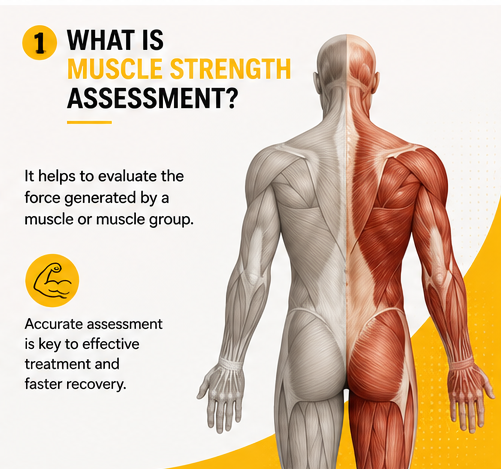
Manual Muscle Testing (MMT) has been the basic method for assessing muscle strength of patients using the therapist's manual resistance which may vary.
However, now with advanced technology Aspire Physiotherapy have objective measures of strength like the hand-held dynamometer which has turned out to be a more objective and reliable tool for Muscle Strength Check.
Let's explore why digital muscle testing offers more accuracy than the age-old manual muscle testing.
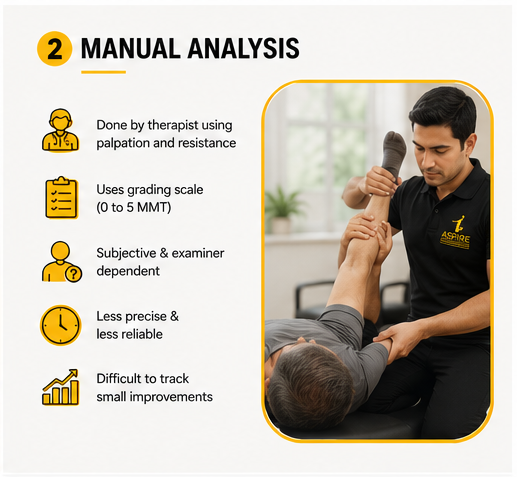
The physiotherapist applies manual resistance to a patient's movement to grade their muscle strength on a scale of 0 to 5.
While MMT is a quick and handy method of testing muscle strength, it has several limitations.
Manual muscle testing uses a therapist's own strength to resist the patient's movement to access their strength, hence the grading largely depends on the therapist's perception and how much strength the therapist is capable of applying.
Intra-rater and inter-rater reliability of MMT is less as two experienced physiotherapists might grade the same patient differently and at the same time two patients who have been graded as grade 5 by the same therapist might have a considerable difference in strength.
Manual muscle testing fails to record minute changes in muscle strength. A patient might still have grade 4 muscle strength but might have improved considerably. MMT does not track progress well.
Therapist's own strength also influences the results of MMT as in some cases like those of sports injuries, the patient's strength might be more than the therapist's. In this case the therapist might not be able to access accurately and track progress.
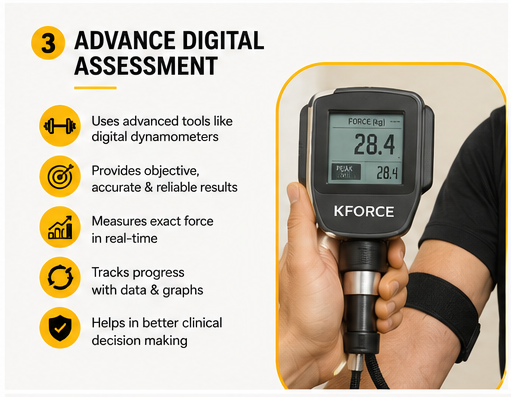
Digital Muscle Testing includes using a digital handheld dynamometer to measure the force generated by a muscle during contraction in Newton, kilograms or pounds.
For example: Week 1: Biceps strength 7.6 kg, Week 3: 8 kg and Week 6: 8.1 kg.
These improvements, although gradual, help the therapist to track progress and motivate the patient towards his recovery.
Gaining muscle is an extremely slow process, it needs consistency and dedication to exercise regularly. A digital dynamometer detects even the smallest improvement in strength which is beneficial in motivating the patient to keep going.
Many researches have concluded that handheld dynamometers when used in the standard way have been far more reliable than manual muscle testing. They offer a higher intra-rater and inter-rater reliability.
So therapists will get consistent readings using a dynamometer and even if a patient is allotted to a different therapist in the course of their treatment, the patient's progress can still be tracked with the use of a dynamometer as it will give similar results and track progress.
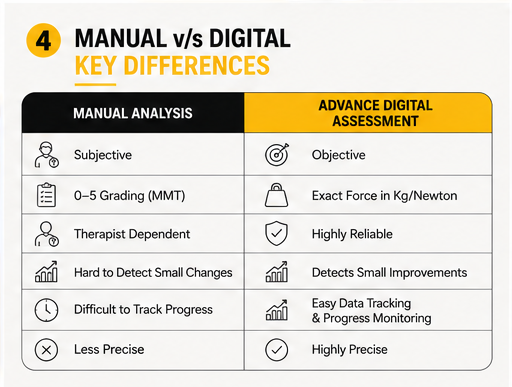
A dynamometer gives accurate numerical values for a muscles strength which helps the therapist make clinical decisions like increasing exercises, increasing resistance or important decisions about whether the patient can start walking, running or going to the gym.
When precise measurements are required, digital muscle testing is far more reliable. It is best to use both whenever required.
While Manual Muscle Testing has been used for ages to access strength by physiotherapists, its has been found to be less reliable for tracking progress. It can still be used when a patient walks in for the first time for quick assessment or when equipment is not available.
However, while tracking muscle strength over a period of time during treatment, for documentation or to track progress a hand-held dynamometer is always superior to manual muscle testing.
Digital muscle testing is far more reliable, sensitive and objective measure of strength that every clinician must inculcate in their practice.
At Aspire Physiotherapy, the goal isn't to replace clinicians but to make them more effective and eliminate human error by adding technology.
MMT is a therapist-based assessment using a 0–5 grading scale, while DMT uses digital devices to objectively measure muscle strength in kilograms or Newtons, providing more accurate and reproducible results.
Yes. DMT provides precise, objective measurements, detects small strength changes, and reduces examiner bias, making it ideal for monitoring rehabilitation progress.
Athletes, individuals recovering from injuries or surgery, people with chronic pain, neurological conditions, and anyone looking to assess muscle imbalances or monitor strength improvements can benefit from DMT.
A comprehensive digital muscle strength assessment typically takes 15–30 minutes, depending on the number of muscle groups being evaluated.
At Aspire Physiotherapy, Digital Muscle Testing is combined with clinical examination to identify muscle weaknesses, create personalized rehabilitation programs, monitor recovery objectively, and optimize return to daily activities or sports.
Let the experts at Aspire Physiotherapy Clinic help you know your fitness score. Visit our clinics in Palam Vihar, Sector 23A or Sector 50, Gurugram for personalized assessment and advanced rehabilitation. We focus on scientific backed digital assessment and not just age old manual testing. Schedule your test today and start your journey toward a stronger, healthier version of you.
Book Your Consultation-+91-9650383603
Authored by:
Dr. Prajakta, B.Pt.
Dr. Prajakta, is a dedicated physiotherapist with a keen interest in evidence-based musculoskeletal rehabilitation and functional assessment. She believes that accurate diagnosis is the foundation of effective treatment and focuses on integrating modern technology with clinical expertise. Through this blog, she explains the differences between Manual Muscle Testing (MMT) and Digital Muscle Testing (DMT), helping readers understand why objective muscle strength assessment leads to more precise treatment planning, better progress tracking, and improved rehabilitation outcomes.