

A tear to the anterior cruciate ligament (ACL) is among the most serious injuries an athlete can suffer. An ACL injury can interfere not only with your ADLs, but also your confidence, performance, and long-term sports aspirations.
Fortunately, an ACL tear is no longer seen as a career-ending injury.
However, getting back to sports is not just a matter of allowing the knee to recover. Aspire Physiotherapy offers systematic, evidence-driven rehabilitation plan that reinstates knee stability, strength, movement quality, neuromuscular control, psychological preparedness, and sport-specific performance. This is the place where your search ACL rehab near me completes.
Here is encompassing guide covers all aspects athletes should understand regarding ACL rehabilitation from grasping the injury and determining the need for surgery to advancing through each rehabilitation stage and securely returning to sports.
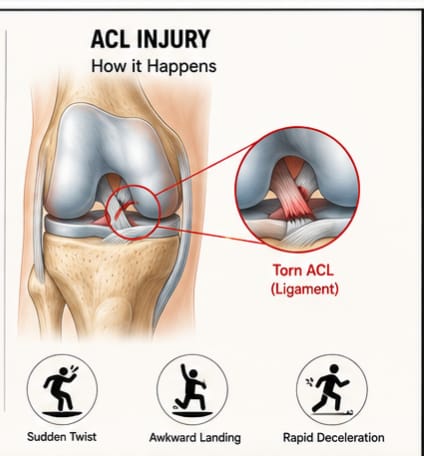
The anterior cruciate ligament (ACL) is one of the four primary ligaments in the knee. It links the femur (thigh bone) to the tibia (shin bone) and is essential for preserving knee stability.
About 70% of ACL injuries occur without any contact.
Typical mechanisms consist of:
Numerous athletes report experiencing a "pop" sound or sensation at the time of injury, accompanied by sudden pain, swelling, and trouble putting weight on it.
Typical symptoms consist of:
Not all ACL injuries result in intense pain. Certain athletes continue to compete for a short time until instability becomes apparent.
ACL injuries are categorized into three grades according to the extent of ligament injury.
Athletes involved in pivoting sports often need reconstruction for complete tears, though not all complete tears necessarily require surgery.
A major question following an ACL injury is if surgery is required.
The response relies on the person—not solely the MRI.
Aspire Physiotherapy Where ACL rehabilitation alone would be appropriate.
Non-surgical management could be appropriate for:
A well-organized ACL rehabilitation plan as at Aspire Physiotherapy can bring back outstanding functionality in thoughtfully chosen individuals.
Benefits:
Effective ACL rehabilitation relies on criteria rather than just the passage of time. Advancement relies on achieving functional milestones.
Fact: Not all ACL injuries require surgery. Many people, especially those with lower activity demands or partial tears, can recover well with structured physiotherapy at Aspire Physiotherapy.
Fact: Pain relief doesn't mean full recovery. Strength, stability, balance, and movement quality must also be restored before returning to sports.
Fact: Most athletes safely return between 9 and 12 months, provided they meet objective return-to-sport criteria rather than just a timeline.
Fact: A brace may provide support or confidence, but it cannot replace proper strength training, neuromuscular control, and movement retraining.
Fact: Running is only one milestone. Athletes must also pass strength, hop, agility, and movement-quality tests before returning to competition.
Fact: Functional recovery matters more than imaging. Athletes should meet clinical and performance criteria before returning to sport.
Studies indicate that coming back too soon greatly heightens the likelihood of re-injury. Decisions regarding return to sport should rely on objective assessments instead of just time.
Aspire Physiotherapy offers Post ACL injury Physical Assessment which includes assessment of strength, flexibility body balance and neuro muscular coordination. Such kind of assessments helps to analyse fair decision to resume sports.
Common Criteria include:
Numerous athletes resume competitive sports within 9 to 12 months after ACL reconstruction, though some need more time based on their sport, strength, and functional recovery.
Physical healing is only one aspect of ACL rehabilitation. Many athletes struggle with fear of re-injury, loss of confidence, frustration, or anxiety about returning to competition.
Working with a sports physiotherapist, maintaining clear rehabilitation goals, tracking progress, and gradually reintroducing sport-specific movements can help rebuild confidence. In some cases, support from a sports psychologist may further enhance return-to-sport outcomes.
What is the duration of ACL rehabilitation?
Recovery differs based on the type of injury, the method of treatment, and the sport involved. Most athletes come back to competitive sports within 9 to 12 months following ACL reconstruction, as long as they fulfil specific strength and functional requirements. Conservative recovery schedules can vary depending on knee stability and activity objectives.
Is it possible for an ACL tear to recover without surgical intervention?
Partial ACL tears and certain complete tears can frequently be effectively treated with physiotherapy, particularly in those who do not engage in pivoting sports. Nevertheless, athletes participating in football, basketball, rugby, or comparable sports often gain advantages from ACL reconstruction because of the significant requirements for knee stability.
When is it safe for me to begin running after ACL surgery?
Running shouldn't start solely based on how much time has passed since surgery. Athletes need to show slight swelling, complete range of motion, sufficient quadriceps strength, and solid single-leg stability prior to beginning a graded running regimen. This typically happens between 3 and 5 months after surgery.
Is physiotherapy essential following ACL surgery?
Indeed. Surgery repairs the ligament physically, while physiotherapy enhances movement, strength, balance, coordination, and sport-specific abilities. Athletes are more likely to experience a lower chance of returning to peak performance and face an increased risk of re-injury without organized rehabilitation.
Is it possible to avoid another ACL injury?
Certainly. Continuous injury prevention initiatives featuring strength training, balance workouts, plyometrics, neuromuscular exercises, correct landing techniques, and organized warm-ups can greatly decrease the likelihood of a subsequent ACL injury.
At Aspire Physiotherapy, we provide personalized assessment, manual therapy, pain management and evidence-based exercise programs to help you recover from ACL injury.
Book Your Consultation-+91-9650383603
Authored by:
Dr. Diwankar Thakur, B.Pt, M.Pt.
Dr. Diwankar Thakur, BPT, MPT, is a musculoskeletal and sports physiotherapist at Aspire Physiotherapy, specializing in ACL rehabilitation, sports injury management, post-operative physiotherapy, knee pain treatment, and return-to-sport rehabilitation. He follows evidence-based rehabilitation protocols combined with advanced movement assessment and individualized exercise programs to help patients recover safely, regain strength and mobility, and prevent re-injury. Passionate about patient education and preventive care, Dr. Thakur regularly shares scientifically backed insights on ACL recovery, knee health, injury prevention, and physiotherapy to help individuals make informed decisions and achieve long-term musculoskeletal wellness.