

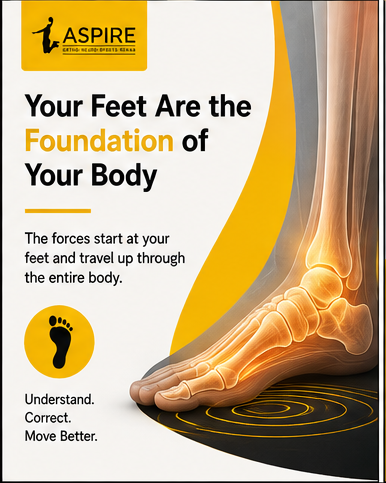
It is very interesting to know that the way you load weight on your foot determines the weight distribution on your knees, pelvis and spine. This is because the whole body is interconnected through a series of kinetic chains, and the movement at one joint can affect the movement at another.
Our feet are the first point of contact with the ground, they decide the entire weight distribution throughout the entire body.
Let us understand that with an example- An individual with flat feet often tends to take more weight on the medial side of the foot due to straightening of the medial arch. If the muscles on the lateral side of the feet aren't strong enough to balance the weight, this individual is prone to developing excessive stress on the medial knee joints and if not looked into might also develop medial knee joint space reduction or osteoarthritic changes in the future.
Individuals with unilateral knee pains distribute more weight on the unaffected leg than the affected. If this gait pattern and loading of weight is not corrected for years, it directly affects the spine- might give back pain or even result in scoliotic changes in the future.
This is why the foot is called the foundation of the body. The forces generated at the feet travel upward through the ankles, knees, hips, pelvis and spine.
This is where foot pressure analysis can provide valuable information.
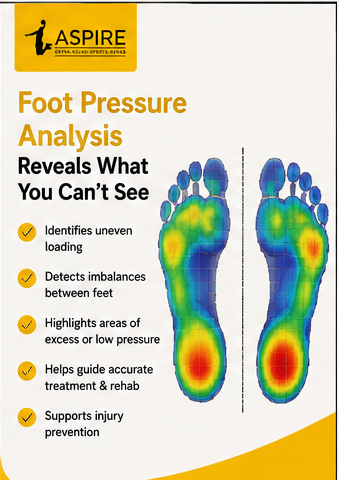
Foot pressure analysis is a method of assessing how pressure is distributed across the sole of the foot while standing or moving.
Using a pressure-sensitive platform or mat, we can observe parameters such as:
Instead of simply looking at where a person feels pain, foot pressure analysis helps us understand how the body is loading and moving.
The foot and knee work together as part of a kinetic chain.
For example, excessive inward rolling of the foot may be associated with changes in the alignment and movement of the lower limb. Similarly, limited foot mobility or an altered loading pattern can change how forces are transmitted through the ankle and knee.
Over time, these altered movement strategies may contribute to increased stress on certain tissues.
However, it is important to remember that an abnormal foot-pressure pattern does not automatically mean it is the cause of knee pain. It is one piece of the clinical puzzle that needs to be interpreted alongside movement assessment, strength, mobility, posture, and the person's symptoms.
The connection becomes even more interesting when we look at the whole body.
When one leg consistently bears more load than the other, or when the feet distribute pressure differently, the body may adapt to maintain balance and forward movement.
These adaptations can involve the:
Foot → Ankle → Knee → Hip → Pelvis → Spine
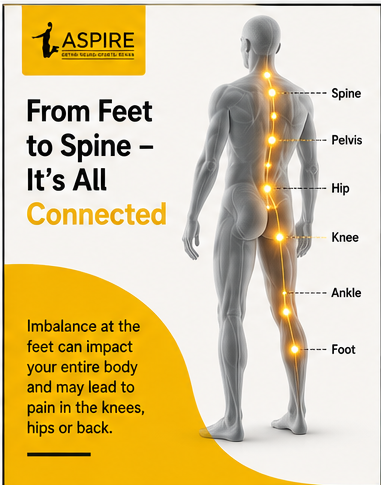
For someone with back pain, assessing the feet can therefore provide additional information about their overall loading strategy.
For example, an asymmetrical loading pattern may encourage compensatory movement at the pelvis or trunk. Identifying such patterns can help a physiotherapist decide whether the treatment should address only the painful area or also include contributing factors elsewhere in the movement chain.
A traditional physical assessment gives us important information about posture, joint range, muscle strength, flexibility, and movement quality.
Foot pressure analysis adds another layer of information: how the body is actually distributing load through the feet.
Two people may look similar while standing but demonstrate very different pressure patterns when walking. This can be particularly useful when symptoms are persistent, recurrent, or difficult to explain through a single joint or muscle.
One of the biggest advantages of foot pressure analysis is that it encourages us to look beyond the painful area.
If a patient comes in with knee pain, we shouldn't automatically assume that the knee is the only problem.
If a patient has lower-back pain, we shouldn't automatically focus only on the spine.
Pain is often the result of multiple interacting factors — including strength, mobility, posture, movement patterns, load management, previous injuries, and biomechanics.
Foot pressure analysis can help identify patterns that may be contributing to the problem, allowing physiotherapy assessment to become more individualized.
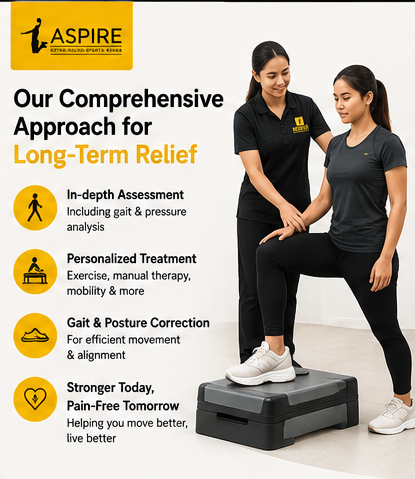
Once an unusual loading pattern is identified, it can be combined with a detailed physiotherapy assessment to develop a targeted treatment plan.
Depending on the findings, treatment may include:
The goal isn't simply to “correct the foot.”
The goal is to understand how the entire movement system is functioning and address the factors that may be contributing to the patient's symptoms.
At Aspire Physiotherapy, we believe effective treatment begins with understanding why the pain is occurring, not just where it hurts. Our comprehensive physiotherapy assessment, supported by Plantar Pressure System Analysis, helps identify abnormal loading patterns and movement strategies that may be contributing to knee, back, or lower-limb pain.
Based on the findings, our physiotherapists develop an individualized treatment plan that may include gait retraining, strengthening, mobility exercises, balance and proprioception training, postural correction, core strengthening, and guidance on footwear and activity modification. Our goal is to address the contributing factors across the entire movement chain and help you move with greater efficiency, confidence, and comfort.
The Bottom Line
Your feet are more than just the structures that carry you around. They are the first point of contact between your body and the ground and play an important role in how forces are transferred through the lower limb.
Foot pressure analysis doesn't diagnose the cause of knee or back pain by itself. Instead, it provides objective information that can complement a comprehensive physiotherapy assessment.
Sometimes, finding the right answer to “Why does my knee or back hurt?” means looking somewhere other than where it hurts.
Because treating the pain is important — but understanding the reason behind it can make the treatment more effective.
What is foot pressure analysis?
Foot pressure analysis assesses how pressure is distributed across the feet while standing or moving. It can identify uneven loading, pressure differences between the feet, and areas of excessive or reduced pressure.
Can foot pressure analysis help identify the cause of knee pain?
Yes. It can reveal altered loading patterns that may contribute to stress on the ankle, knee, hip, and other parts of the movement chain. However, the findings should always be interpreted alongside a comprehensive physiotherapy assessment.
How can foot pressure affect back pain?
Uneven weight distribution between the feet can lead to compensatory movements through the legs, pelvis, and spine. Assessing these patterns may provide useful information about an individual's overall movement and loading strategy.
Is foot pressure analysis enough to diagnose knee or back pain?
No. Foot pressure analysis does not diagnose the cause of pain by itself. It is an additional assessment tool used along with strength, mobility, posture, gait, movement quality, and symptoms.
What happens after an abnormal pressure pattern is identified?
The findings can help physiotherapists develop a personalized treatment plan, which may include strengthening, mobility exercises, balance training, gait retraining, postural correction, core exercises, and activity or footwear guidance.
Who can benefit from foot pressure analysis at Aspire Physiotherapy?
It can be particularly useful for people with persistent, recurrent, or unexplained knee, back, or lower-limb symptoms, especially when conventional assessment does not fully explain the problem. The goal is to understand contributing factors and support more individualized treatment.
Let the experts at Aspire Physiotherapy help you know your current fitness profile. Visit our clinics in Palam Vihar, Sector 23A or Sector 50, Gurugram for personalized assessment, training, physiotherapy and advanced rehabilitation. We focus on assessing the root cause and not just the symptoms for long-lasting results. Schedule your consultation today and start your journey toward a stronger, healthier version of you.
Book Your Assessment-+91-9650383603
Authored by:
Dr. Prajakta, B.Pt.
Dr. Prajakta, is a dedicated physiotherapist with a keen interest in evidence-based musculoskeletal rehabilitation and functional assessment. She believes that accurate diagnosis is the foundation of effective treatment and focuses on integrating modern technology with clinical expertise. Through this assessment she leads to more precise treatment planning, better progress tracking, and improved rehabilitation outcomes.